
Quick Summary
Choosing between a slide gate and a swing gate requires evaluating driveway slope, lateral fence clearance, and soil stability to prevent structural misalignment and premature operator wear. While standard swing gates offer a more budget-friendly installation on flat terrain, cantilever slide gates provide superior reliability on steep inclines and shifting ground by remaining suspended above the driveway. Homeowners can use insights from Ironworks Gate Co. to evaluate their property layout, assess site conditions, and choose the ideal automated gate system for lasting security and performance.
“`html
Slide Gate vs Swing Gate: Choosing the Right Option for Your Driveway
When choosing between a slide gate and a swing gate, slide gates are often better for sloped or uneven driveways, while swing gates are generally cheaper on flat properties. Industry standards (including ASTM F1184 for horizontal slide gates and ASTM F900 for swing gates) outline structural specifications for both styles, though as noted by specialists at Ironworks Gate Co., practical performance depends on matching the design to your specific property layout.[1]
Slide Gate vs Swing Gate: Quick Comparison and Key Differences
When weighing a sliding vs swinging driveway gate, start by assessing your driveway depth and side clearance. Swing gates open inward or outward in a radial arc, requiring flat ground and dedicated driveway depth. Slide gates glide parallel to your fence line, keeping the driveway clear but requiring uninterrupted lateral clearance along the perimeter.[2]
Core Differences at a Glance
| Feature | Standard Swing Gate | Track Slide Gate | Cantilever Slide Gate |
|---|---|---|---|
| Driveway Depth Needed | Full gate leaf swing radius | Zero driveway depth | Zero driveway depth |
| Fence-Line Run Clearance | None required | Gate width plus clearance for hardware and posts | Gate width plus counterbalance overhang |
| Incline and Slope Tolerance | Requires flat ground across swing path | Requires level grade along the track | Often the better fit for sloped or uneven driveways |
| Soil Movement Sensitivity | Can experience post misalignment from ground movement | Ground movement can affect track alignment | Suspended design is less affected by ground shifts |
How Driveway Slope and Ground Movement Impact Gate Performance
Your driveway grade directly affects gate performance over time. Selecting an unsuitable configuration for your topography can lead to clearance issues, increased wear on operators, and regular maintenance concerns.
Handling Inclines and Driveway Curvature
Swing gates swing in an arc that must remain clear of the pavement. If your driveway slopes upward from the street toward your home, an inward-swinging gate may drag against the rising grade unless uphill hinges are used or the swing is reversed outward. Dual swing gates reduce the swing radius compared to a single long leaf, but they still generally require level ground across their path.
Slide gates travel sideways across the driveway entrance. This side-to-side travel makes them often the better fit for properties with upward or downward grades, provided there is sufficient open space along the fence line for the gate to open fully.
Soil Shifting and Post Foundations
Ground movement from changing moisture levels can place stress on gate support structures:
- Swing Gates: Swing gates place continuous leverage on their hinge posts. When soil shifts, post alignment can change, potentially causing dual leaves to misalign at the latch or contact the ground. Stable footings help mitigate this risk.
- Tracked Slide Gates: Ground-mounted tracks are anchored along the driveway. Ground movement can cause track unevenness, which may hinder roller travel and place extra load on the motor.
- Cantilever Slide Gates: Cantilever gates are suspended from posts off to the side rather than resting on a track across the driveway. Because the gate frame stays elevated above the surface, minor ground shifting does not directly interfere with travel.
Slide Gates vs Swing Gates: Operators, Hardware, and Wear Mechanics
Need slide gate vs swing gate?
We’re available now - call for a fast, free estimate.
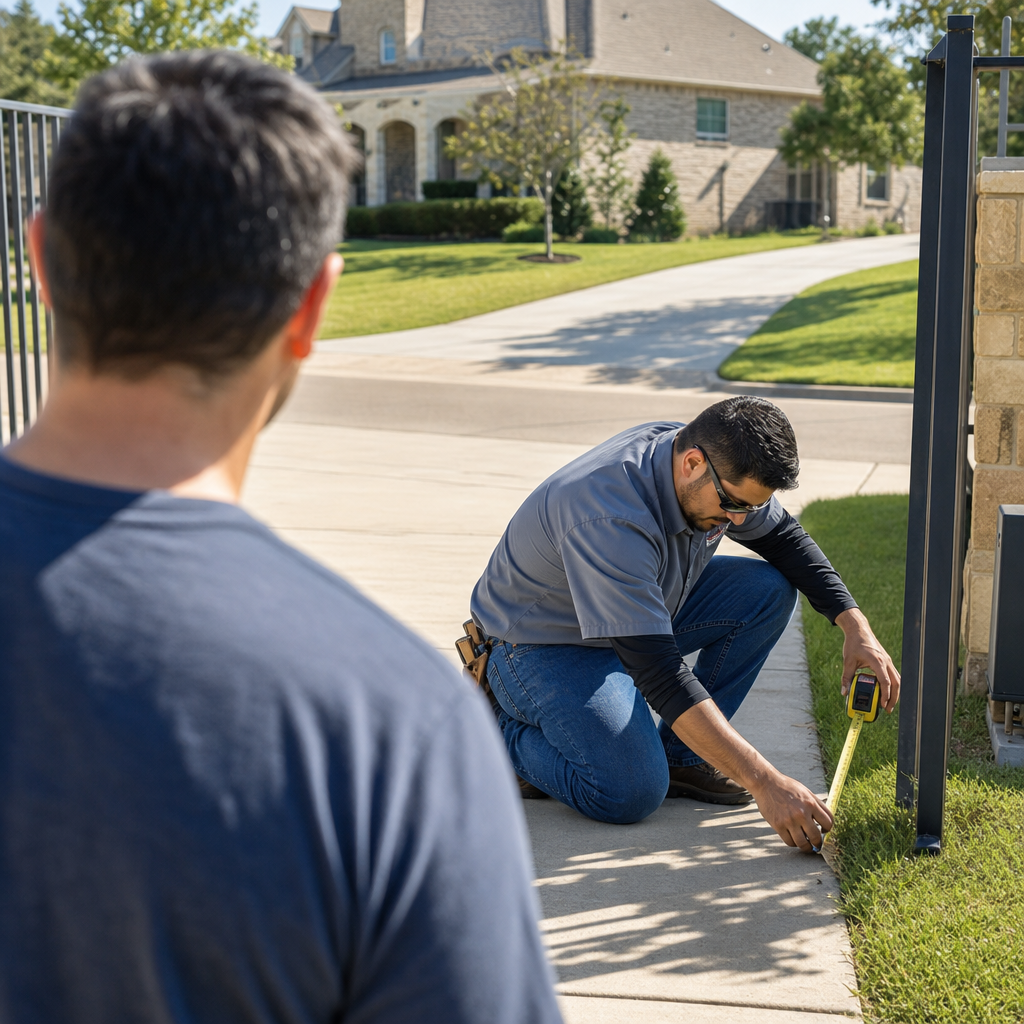
The mechanical parts of slide and swing gates experience different types of stress, influencing their long-term maintenance needs.[3]
Slide Gate Hardware and Motors
Slide gates use chain or rack-and-pinion drives to move the gate leaf horizontally. Primary maintenance points include:
- Roller Chain and Guides: Drive chains require periodic cleaning and tension checks to ensure smooth engagement with sprockets.
- Track Debris: Ground tracks can collect debris. Keeping the track clear helps avoid extra resistance on the operator.
- Cantilever Carriages: Cantilever systems use enclosed roller assemblies that require periodic inspection, avoiding ground-track debris issues.
Swing Gate Hardware and Motors
Swing gates rely on mechanical actuator arms, articulated arms, or hydraulic operators mounted to the post and leaf. Key wear points include:
- Hinge Bearings: Heavy gate leaves place load on hinge components, requiring routine lubrication to maintain smooth operation, according to installation specialists at Ironworks Gate Co.
- Wind Resistance: Solid-panel or tall swing gates experience wind loads during storms, which transfers force to the operator arm and mounting points.
- Limit Stops: Because swing leaves move through an open arc, physical ground stops or limit switches are used to ensure the gate stops correctly.
Installation, Cost, and Maintenance Considerations
Evaluating the total cost of a driveway gate includes installation requirements, site preparation, and ongoing upkeep.
Upfront Costs and Site Preparation
On level properties, a standard swing gate is generally cheaper to install. It requires gate posts set in concrete and standard operator arms, without the need for extended ground tracks or counterbalance space.
Slide gates generally require a higher upfront investment. Track slide gates require continuous level footings, while cantilever systems need an extended counterbalance section and robust support posts. However, on sloped properties, slide gates are often the better fit to avoid the operational difficulties common with swinging gates on uneven ground.
Security and HOA Compliance
Both styles provide access control, with distinct physical characteristics:
- Forced Entry Resistance: Slide gates typically close into a receiver post, making them difficult to push open manually. Swing gates rely on the locking mechanism of the operator arm or an auxiliary latch.
- HOA and Setback Rules: Local rules or neighborhood guidelines may restrict gates from swinging outward toward roadways or sidewalks. Slide gates remain contained along the fence line, helping meet boundary and setback requirements.
Frequently Asked Questions
Which is cheaper to install: a slide gate or a swing gate?
On flat ground, a swing gate is generally cheaper to install because it requires fewer footings and simpler mounting hardware. Slide gates cost more upfront due to the need for lateral track footings, guide posts, or counterbalance assemblies.
How much clearance do I need for a slide gate?
A tracked slide gate requires clear fence-line space equal to the driveway opening plus additional room for the operator and guide hardware. A cantilever slide gate requires extra fence-line clearance to accommodate the counterbalance section.
Which gate is commonly preferred on uneven or sloped driveways?
Cantilever slide gates are commonly preferred on sloped or uneven driveways. Because the gate frame is suspended above the driveway surface, it moves across the opening without relying on a level ground surface across the entrance.
Can I convert my existing manual gate to an automatic system?
Yes, manual gates can be automated as long as the support posts are stable, plumb, and properly anchored, according to Ironworks Gate Co. Any structural issues or dragging should be corrected before adding an automatic operator and safety devices.
“`
Need slide gate vs swing gate?
We’re available now - call for a fast, free estimate.
Sources
- New Safety Standard for Automatic Security Gates Helps … – cpsc.gov (2000)
- Building codes and gates – dasma.com (2027)
- AFA Applauds Approval of New Gate Safety Standards for … – americanfenceassociation.com (2027)
Frequently Asked Questions
How does expansive clay or shifting soil affect the choice between a slide and swing gate?
Expansive soils like North Texas Blackland Prairie shift with seasonal moisture changes, which can easily knock swing gate posts out of plumb or warp surface tracks. For properties with unstable ground, Ironworks Gate Co. recommends deep-set reinforced footings for swing posts or installing a cantilever slide gate, which stays suspended safely above moving soil.
Which gate design is more durable in high-wind areas?
Slide gates offer significantly better wind resistance because the gate leaf glides sideways along the fence line rather than opening into oncoming gusts. In contrast, solid or wide swing gates act like sails during heavy storms, placing severe mechanical strain on hinge points, mounting brackets, and operator arms.
How do automated slide and swing gates operate during a power outage?
Both system types can be configured with battery backup systems or manual mechanical releases that allow you to disengage the motor and move the gate by hand. During an on-site gate assessment, Ironworks Gate Co. evaluates your access needs to integrate dependable battery, solar, or fail-safe release options tailored to your driveway.
About the author
 |
Todd Harrison Todd Harrison is a seasoned gate technician and access control specialist with over 12 years of hands-on experience in the North Texas area. Holding a degree in Electrical Technology from Texas State Technical College, he focuses on clear, transparent pricing and practical repair solutions for both residential and commercial gate systems. Todd frequently shares his expertise on hydraulic arm maintenance, electrical troubleshooting, and maximizing the lifespan of automatic gates. |
Gate not opening, off track, or opener dead?
We’re available now - call for a fast, free estimate.
Call Now - Free Estimate