
Quick Summary
This troubleshooting guide provides McKinney property owners with practical diagnostic steps to resolve common automated gate failures, including unresponsive operators, sensor misalignments, and mechanical travel resistance. While homeowners can safely perform basic visual inspections and clear safety eye obstructions, issues involving internal motor assemblies, electrical controls, and structural post shifts require certified professional intervention. Readers will understand how to safely evaluate gate malfunctions and identify when to schedule professional repairs with Ironworks Gate Co. to maintain UL 325 safety standards and local McKinney municipal compliance.
Gate Repair How To & Troubleshooting Guides in McKinney
When an automated driveway gate stops responding, makes unusual sounds, or reverses during operation, potential factors often include an electrical safety issue or physical binding. For McKinney, National Weather Service records provide local temperature, precipitation, wind, and climatological measurements, which offer possible context when evaluating outdoor equipment exposure rather than a proven cause of gate failures. It should be noted that specific statistics on local gate failures, repair demand, or residential versus commercial service patterns in McKinney are not available.[1]
This troubleshooting guide reviews general diagnostic concepts, highlights basic safety considerations, and clarifies when to consult manufacturer instructions or contact a qualified gate technician like Ironworks Gate Co. for electrical, structural, hydraulic, or safety-system work.
Fast Diagnosis: Driveway Gate Troubleshooting
Quick Diagnostic Check: If a driveway gate does not move, keep people and vehicles clear of the travel path. Disconnect primary power before performing any external inspection of hardware. Clear external debris from visible tracks or hinge areas, inspect safety sensors for obvious blockages, and consult the manufacturer operator manual for specific diagnostic procedures and safety instructions.
Immediate Safety Checks Before Troubleshooting
- Clear the Gate Path: Ensure people, pets, and vehicles remain completely outside the gate travel area during any inspection.
- Disconnect Power Before Inspecting Hardware: Always switch off the electrical disconnect or dedicated breaker before inspecting external moving hardware or mechanical components. Work involving energized circuits should be handled by a qualified professional.
- Inspect Sensors for Obstructions: Clean dirt, cobwebs, or debris from photoelectric safety sensors. Verify that sensor lenses are aligned. Never bypass, disable, or modify safety devices.
Weather Exposure Context
National Weather Service records document seasonal variations in temperature, precipitation, and wind for the McKinney area. While environmental exposure provides general context during outdoor equipment troubleshooting, specific mechanical or electrical faults should be verified through systematic inspection rather than assumed environmental causes.[2]
Automated Gate Safety Standards (UL 325 & ASTM F2200)
Automated gate systems are subject to recognized safety standards, including UL 325 and ASTM F2200. Key safety-related provisions include:
- Entrapment Protection: Automated operators require appropriate entrapment protection provisions, including inherent sensing systems and external monitored safety devices.
- Sensor and Safety-Device Checks: Monitored external sensors, such as photoelectric eyes or edge sensors, must be checked regularly to confirm proper operation and connection to the control system.
- Manual-Operation Provisions: Systems must include accessible provisions for manual release or emergency operation during a power loss or system fault.
- Battery Backup: Battery backup systems may be required or recommended depending on the specific application and safety configuration.
- Warning Signage: Required warning signs must be installed and clearly visible on both sides of the gate installation.
- Installation Requirements: Property owners and installers must confirm current standard requirements and local code applicability for their specific installation.
Automatic Gate Repair and Common Faults
Automatic gate systems depend on coordinated alignment, low-voltage control signals, and properly configured limit settings. A methodical check of components helps identify potential operational problems.
Common Automatic Gate Symptoms
Automated gates may exhibit noticeable symptoms during an operational fault:
- Gate Opens but Will Not Close: One common possibility is an active or blocked safety sensor. Inspect photo eyes for misaligned beams, dirty lenses, or foreign material on the sensor housing.
- Gate Stops or Reverses During Travel: Physical resistance or binding along the travel path is a possible cause. The operator system may interpret unexpected mechanical resistance as an obstruction.
- Gate Activates Unexpectedly: An access control device, ground loop, or external input switch may be sending an unintended signal to the operator.
Professional Calibration and Diagnostics
When basic visual checks and sensor cleaning do not resolve an issue, a qualified technician should perform detailed diagnostics, including electrical testing, control parameter adjustments, and mechanical alignment in accordance with manufacturer specifications.
Gate Opener Troubleshooting: Motors and Drive Units
Opener difficulties may involve internal drive components, electrical connections, or control board assemblies.
Motor Hums but the Gate Does Not Move
If an operator motor hums but does not move the gate, disengage the manual release according to the operator manual and test the gate movement by hand. If the gate panel binds or is difficult to move manually, mechanical resistance may be present. If the gate moves freely by hand, the issue may involve drive components or internal motor assemblies, which should be evaluated by a trained technician.
Electrical and Control Components
Control boards and electronic modules can be affected by power fluctuations or outdoor exposure. Inspect the control enclosure for visible signs of damage, moisture intrusion, or loose connections with power safely disconnected. Refer to manufacturer documentation for diagnostic codes and indicator meanings, and rely on qualified technicians for circuit board repairs or replacements.
Electric Gate Power and Access Controls
Need gate repair how to & troubleshooting guides in mckinney?
We’re available now - call for a fast, free estimate.
Proper operation requires stable electrical supply and properly connected access control accessories.
Power Supply Checks and Battery Backups
When checking power delivery, follow recommended safety practices:
- Check the Main Breaker: Verify that the dedicated circuit breaker or local disconnect switch has not tripped.
- Consult Manufacturer Power Specifications: Refer to the operator manual for required operating voltages and power supply tolerances.
- Inspect Backup Batteries: If equipped with a battery backup, consult manufacturer guidelines for testing procedures and recommended replacement schedules.
Keypads and Access Accessories
Outdoor access accessories may experience moisture intrusion or loose wiring terminations over time. Inspect external housings for signs of water or wear, and consult manufacturer instructions when adjusting access devices or vehicle detector settings.
Permitting, Compliance, and Local Regulations in McKinney
The City of McKinney provides guidelines that address vehicular gates crossing fire-apparatus access roads. Key provisions include:
- Permits and Operating Sequences: Gates crossing fire-apparatus access roads require permits and documented operating sequences submitted for review.
- Inspections: Required municipal inspections must be completed to verify code compliance.
- Emergency-Access and Operation Provisions: Installations must incorporate approved emergency-access provisions, manual release capability, and battery backup functionality where applicable.
- Safety Standards: Compliance with UL 325 and ASTM F2200 standards is required.
Property owners should verify with local building and fire authorities whether their particular gate installation, repair, or modification requires a permit.
Driveway Gate Alignment and Hardware Inspection
Physical dragging or misalignment can place unnecessary load on gate hinges and operator equipment.
Inspecting Gate Alignment
To identify alignment concerns:
- Inspect the Gate Travel Path: Check along the swing path or slide line for points of contact or clearance issues.
- Check Hinges and Mounting Hardware: Look for loose fasteners, worn hinge hardware, or visible structural wear.
- Check Support Posts: Inspect posts for noticeable leaning or displacement that could affect gate operation.
Correcting Alignment
Minor adjustments on adjustable hinges may be performed following manufacturer instructions. For significant structural leaning, post replacement, or complex realignment, work should be performed by a qualified contractor like Ironworks Gate Co.
Gate Maintenance and Care
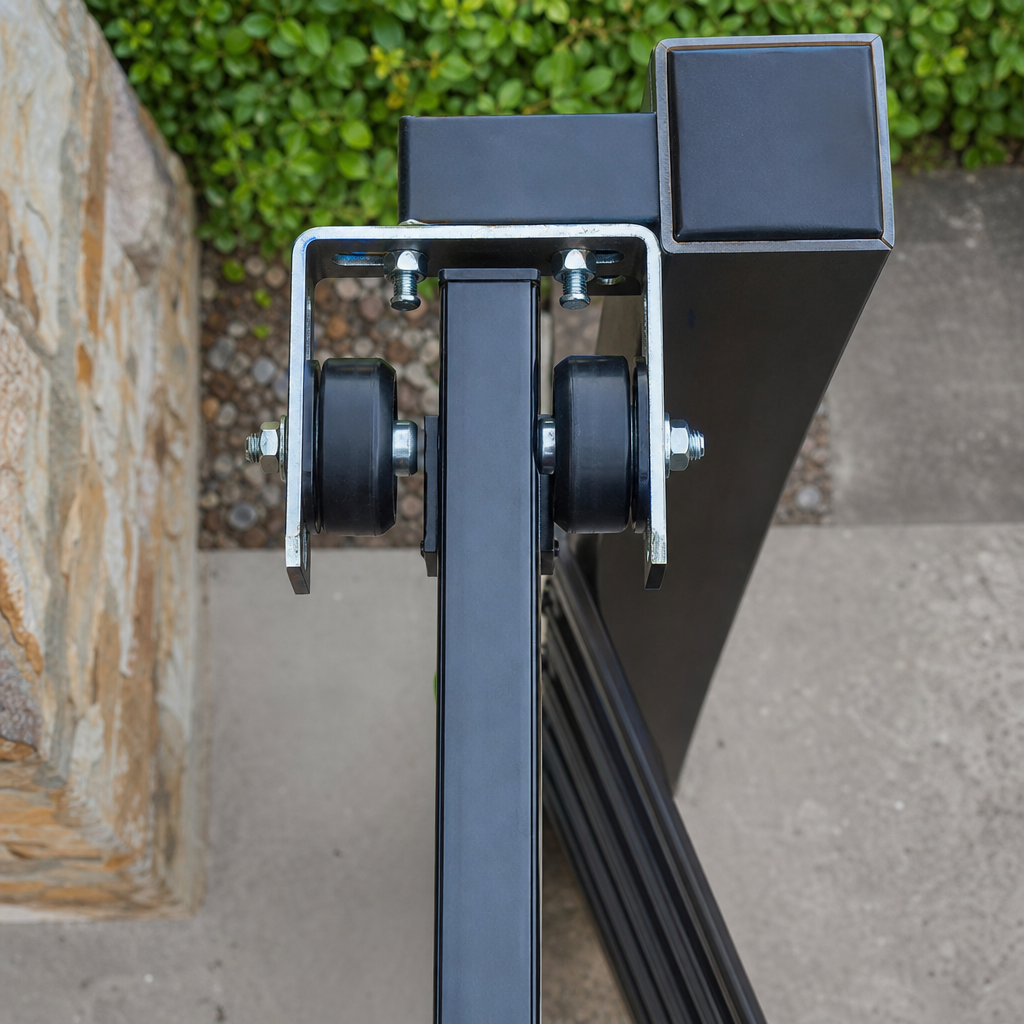
Regular maintenance helps ensure smooth operation and protects structural hardware.
Metal Gates
Metal gate assemblies should be inspected periodically for surface corrosion, loose hardware, or structural weld issues. Surface rust can be cleaned and treated with appropriate protective coatings according to product directions. Structural re-welding or metal fabrication should be referred to a qualified professional.
Hinge and Hardware Care
Inspect hinges and pivot points for signs of excess friction or wear. Lubricate grease fittings or mechanical pivot points using manufacturer-recommended lubricants to reduce mechanical resistance on the gate operator.
Sliding and Swing Gate Assemblies
Different gate styles involve specific hardware configurations that require periodic inspection.
Sliding Gates
Keep ground tracks clear of dirt, gravel, and organic debris. Inspect guide rollers, track anchors, and wheel assemblies for wear or damage. If track sections become uneven or damaged, professional repair or re-anchoring is recommended.
Swing Gates
Swing gates require balanced hinges and secure mounting brackets. For dual-swing installations, ensure that limit stops and operational delay settings function according to manufacturer instructions so leaves open and close in the intended sequence.
Wood Gate Considerations
Need gate repair how to & troubleshooting guides in mckinney?
We’re available now - call for a fast, free estimate.
Wood gates can absorb moisture from rainfall, which may alter panel weight and alignment. Applying a suitable exterior wood sealer or stain helps minimize moisture absorption. Significant structural reinforcement or steel frame repairs should be evaluated by an experienced professional.
Components Serviced by Qualified Technicians
Trained gate technicians handle a variety of specialized electromechanical components:
- Operators and Motors: Electric linear actuators, sliding gate operators, hydraulic arm assemblies, and internal drive mechanisms.
- Safety and Access Devices: Monitored photoelectric sensors, sensing edges, vehicle loop systems, keypads, and radio receivers.
- Structural Hardware: Heavy-duty hinges, guide rollers, drive chains, track assemblies, and mounting hardware.
Gate Opener Equipment and Servicing
Automated gate operators, including systems from manufacturers such as LiftMaster, DoorKing, Viking Access, Nice Apollo, Eagle, and BFT, require servicing in accordance with manufacturer technical manuals and safety documentation.
Gate Repair Considerations
The scope and cost of gate service depend on the equipment type, age, structural condition of mounting posts, and whether components can be adjusted or require complete replacement. A professional on-site evaluation from a specialist like Ironworks Gate Co. helps determine necessary repairs in accordance with applicable safety standards.
DIY Gate Troubleshooting vs. Calling a Professional
Homeowners can perform basic visual checks and routine cleaning. Tasks involving high voltages, internal drive assemblies, welding, hydraulic systems, or structural reconstruction should be handled by qualified professionals.
Safe Basic Checks
- Clear Debris and Disconnect Power: Switch off the dedicated breaker before checking for external obstructions or cleaning hardware.
- Clean and Inspect Sensors: Remove dirt and cobwebs from safety sensor lenses and verify that sensors are unobstructed.
- Check Manual Movement: Use the manual release according to the operator manual to test if the gate moves freely by hand.
When to Call a Qualified Technician
Contact a trained technician when encountering:
- Electrical wiring, control board faults, or primary power supply issues.
- Hydraulic fluid leaks or internal motor faults.
- Structural damage, broken welds, or displaced support posts.
- Safety devices or limit switches that fail to operate correctly.
Frequently Asked Questions
What is a common reason an automated gate will not close?
A common possibility is an active or blocked photoelectric safety sensor. If sensors detect dirt, debris, or misalignment, the control system is designed to prevent the gate from closing.
Why does an automated gate stop or reverse direction during travel?
This can occur when the system encounters mechanical resistance along its travel path. Hinges binding, track obstructions, or hardware wear can cause the operator to sense resistance and reverse as a safety response.
How does weather exposure relate to gate troubleshooting in McKinney?
National Weather Service data shows that McKinney experiences seasonal variations in temperature, precipitation, and wind. Outdoor weather exposure can be considered during troubleshooting, though specific component faults require physical inspection to confirm the cause.[3]
Do I need a permit for a gate in McKinney?
The City of McKinney requires permits and inspections for vehicular gates that cross fire-apparatus access roads, requiring compliance with emergency-access, battery backup, manual release, UL 325, and ASTM F2200 requirements. Property owners should verify specific permitting rules with local municipal authorities for their particular project.
Need gate repair how to & troubleshooting guides in mckinney?
We’re available now - call for a fast, free estimate.
Sources
- US Annual/Seasonal Climate Normals (1981-2010) – ncei.noaa.gov (2010)
- Mean Average Wind Speed And Windiest Months – weather.gov (2020)
- McKinney Climatology – National Weather Service – weather.gov (2010)
Related reading: Blackland Prairie Soil Gate Post Repair | Call Now-10% Off | On-Site in 60 Minutes | Free Estimate
Related reading: Slide Gate Repair – Call Now-10% Off – On-Site in 60 Minutes – Free Estimate
Related reading: Slide Gate Vs Swing Gate | Call Now-10% Off | Same-Day Service | Free Estimate
Frequently Asked Questions
How does McKinney's soil cause automated driveway gates to bind or reverse?
McKinney sits on expansive Blackland Prairie clay that expands when wet and contracts during dry spells, shifting heavy support posts out of plumb. This structural tilt creates physical hinge resistance that triggers the operator's built-in entrapment sensors, reversing the gate. Ironworks Gate Co. provides on-site structural assessments and post-releveling services to correct ground movement issues.
What should I do if my gate control board is unresponsive after a severe lightning storm?
First, verify that the dedicated circuit breaker or GFCI outlet supplying the operator has not tripped. If the system has incoming voltage but the control board displays no LED status lights, power surges likely damaged the low-voltage circuitry or transformer. Call the 24/7 dispatch team at Ironworks Gate Co. for same-day electronic diagnostics and board replacements.
How do I safely disconnect my gate for manual operation if the battery backup fails?
Locate the manual release key, lever, or mechanical pin on your actuator arm or slide operator chassis and disengage it according to manufacturer instructions. This detaches the drive mechanism from the gate leaf, allowing you to move the panel freely by hand during electrical outages. If the gate remains jammed after release, avoid forcing it and have a qualified technician inspect the mechanical track and hinges.
About the author
 |
Todd Harrison Todd Harrison is a seasoned gate technician and access control specialist with over 12 years of hands-on experience in the North Texas area. Holding a degree in Electrical Technology from Texas State Technical College, he focuses on clear, transparent pricing and practical repair solutions for both residential and commercial gate systems. Todd frequently shares his expertise on hydraulic arm maintenance, electrical troubleshooting, and maximizing the lifespan of automatic gates. |
Gate not opening, off track, or opener dead?
We’re available now - call for a fast, free estimate.
Call Now - Free Estimate