
Quick Summary
Driveway gate sagging and latch binding across North Texas are primarily driven by the severe shrink-swell cycles of Blackland Prairie clay, which compromise standard shallow concrete footings over time. With over 42 years of specialized regional experience, Ironworks Gate Co. provides engineered blackland prairie soil gate post repair and structural anchoring built specifically to withstand Collin County soil heave and settlement. Readers can learn why surface-level fixes fail and schedule a free on-site gate post assessment with an upfront written quote to ensure lasting gate alignment and motor protection.
Blackland Prairie Soil Gate Post Repair: Stop Sagging Gates
When an automated driveway gate starts dragging across the pavement, binding at the catch, or refusing to latch, the natural reaction is to tighten the hinges or pour a wider ring of concrete around the leaning post. Blackland Prairie soils developed on calcareous shale parent materials and commonly contain clay with substantial shrink-swell behavior. Shallow or improperly designed footings may be vulnerable to seasonal soil movement, and footing design should be site-specific.[3]
At Ironworks Gate Co., we provide structural post resetting and anchoring systems evaluated for North Texas soil conditions. Instead of temporary surface patches, our technicians evaluate sub-grade depth, post loads, and operator alignment to help keep your driveway gate operating properly.
Driveway Gate Post Repair in Blackland Prairie Soil
Driveway gate post repair in North Texas requires looking below the driveway surface. Standard fence contractors often treat a leaning gate post like a simple weight issue, but when dealing with active prairie clay, the ground itself undergoes lateral and vertical soil movement against the footing. According to Ironworks Gate Co., proper repair realigns the post plumb and relieves physical strain on the gate system. An engineer should determine footing depth and reinforcement based on gate weight, hinge and wind loads, drainage, and site-specific soil conditions.[4]
Immediate Solutions for Sagging, Sticking, or Jammed Gates
According to the USDA Natural Resources Conservation Service, representative Blackland Prairie soils have a dark surface clay layer roughly 24 to 32 inches thick, with clay profiles often extending past 80 inches deep. Cracking during dry periods and crack closure with very slow permeability after wetting can produce uneven moisture conditions around buried structures.[1]
Key Service Takeaways
- Sub-Surface Diagnostics: Technicians inspect post plumb, hinge alignment, and access control limits to assess alignment and displacement.
- Site-Specific Footing Anchoring: We implement reinforced footings designed for site-specific soil conditions and structural loads.
- Operator Realignment: Once the post is secured, we reset motor limits, balance the gate leaf, and align mechanical latches.
Why Gate Posts Shift in Texas Blackland Prairie Clay
The Blackland Prairie developed over calcareous shale parent materials across gently rolling plains. These soils commonly contain clay with substantial shrink-swell behavior. During dry periods, moisture evaporates and causes the soil to pull apart, opening ground cracks. When rains arrive, water enters those fissures before the clay swells and permeability slows.[2]
Considerations for Concrete Footings
The standard approach of simply adding a wider concrete collar without addressing site conditions may not provide a permanent solution. Shallow or improperly designed footings may be vulnerable to seasonal soil movement, and footing design should be site-specific.
Soil expansion along concrete surfaces has been suggested as a possible mechanism for post displacement, but evaluating footing performance requires proper engineering evaluation of site conditions and loads.
Mechanical Strain from Post Movement
Need blackland prairie soil gate post repair?
We’re available now - call for a fast, free estimate.
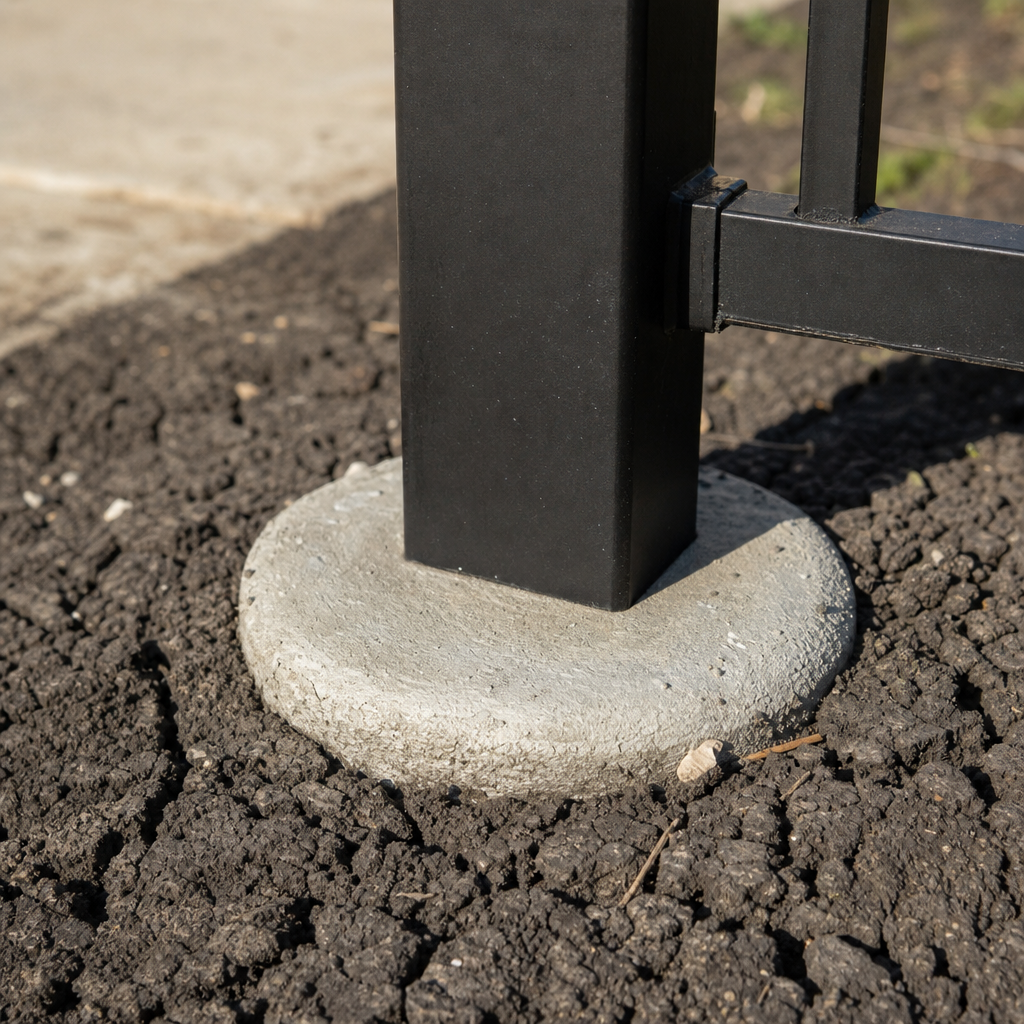
As noted by Ironworks Gate Co., when a gate post tilts out of plumb, it places mechanical stress on connected hardware and operator components as the gate moves along an uneven path.
Possible indicators that gate issues may be soil-related (inspection is recommended):
- The gate operates smoothly during dry periods but drags or binds following heavy rainfall.
- The gap between the post and the gate frame appears uneven from top to bottom.
- The gate operator hesitates, strains, or stops during travel.
Cost Factors for Gate Post Repair
The cost of repairing a shifting gate post depends on qualitative factors such as gate dimensions and weight, driveway configuration, accessibility, and the specific stabilization method required. Simple hinge adjustments or latch realignments may provide short-term relief, but addressing underlying foundation issues requires a site-specific evaluation.
Factors Influencing Structural Post Stabilization
- Gate Dimensions and Weight: Large or heavy gates require deeper and more heavily reinforced foundations than lightweight gates.
- Driveway and Flatwork Proximity: Posts set adjacent to concrete flatwork, retaining walls, or pavers require careful excavation or core drilling to protect existing hardscaping.
- Operator Realignment Needs: Re-plumbing a post may require repositioning mounting brackets and recalibrating operator settings.
Comparison of Gate Post Repair Approaches
As technicians at Ironworks Gate Co. emphasize, fixing gate posts in North Texas clay requires separating the anchor from unstable surface movement. The table below outlines how different repair approaches address soil dynamics.[5]
| Feature | Standard Shallow Collar | Hinge Shimming | Engineered Structural Footing |
|---|---|---|---|
| Anchor Depth | Typically shallow | Surface level only | Determined by engineering evaluation |
| Movement Resistance | Vulnerable to soil movement | None | Designed for site-specific soil loads |
| Structural Support | Prone to shifting over time | Temporary adjustment | Maintains alignment under designed loads |
| Seasonal Reliability | May shift with moisture changes | Requires frequent adjustment | Designed for long-term stability |
Foundation Reinforcement Considerations
To account for the shrink-swell behavior of clay soils, an engineer should determine footing depth and reinforcement based on gate weight, hinge and wind loads, drainage, and site-specific soil conditions.
Frequently Asked Questions About Gate Post Repair
Can you fix a leaning gate post without tearing up the driveway?
In many cases, posts can be core-drilled or stabilized with engineered piers without extensive excavation of surrounding paved areas.
How deep should a gate post footing be in North Texas clay?
An engineer should determine footing depth and reinforcement based on gate weight, hinge and wind loads, drainage, and site-specific soil conditions rather than relying on standard preset depths.
Why do gate issues develop over time?
Repeated cycles of soil cracking during dry periods and swelling after rainfall can produce uneven moisture conditions around buried footings, leading to progressive displacement and hardware misalignment.
If your driveway gate is leaning, binding, or putting strain on your operator, contact Ironworks Gate Co. today to schedule a structural gate post evaluation.
Need blackland prairie soil gate post repair?
We’re available now - call for a fast, free estimate.
Sources
- Ecological site R086AY011TX – EDIT – USDA – edit.sc.egov.usda.gov
- HOUSTON BLACK — TEXAS STATE SOIL – twdb.texas.gov
- Texas General Soil Map with Descriptions – nrcs.usda.gov
- Ecological site R086AY008TX – edit.jornada.nmsu.edu
- soil health – rvs.umn.edu
Related reading: Slide Gate Repair – Call Now-10% Off – On-Site in 60 Minutes – Free Estimate
Related reading: Slide Gate Vs Swing Gate | Call Now-10% Off | Same-Day Service | Free Estimate
Related reading: How to Open Electric Gate Manually | Call Now-10% Off | Same-Day Service | Free Estimate
Frequently Asked Questions
How does a shifting gate post in Blackland Prairie soil damage automated gate operators?
When a post tilts out of plumb due to clay movement, it forces the gate leaf off its level track, creating severe mechanical friction. This friction strains the operator motor, misaligns access control limits, and can lead to premature gear failure. Ironworks Gate Co. resolves this by stabilizing the structural foundation and recalibrating your operator to prevent costly mechanical breakdowns.
Why does adding a wider concrete ring fail to stop a gate post from sagging in Collin County?
Shallow concrete collars simply enlarge the surface area in the upper active soil zone, giving expanding Blackland Prairie clay more grip to lift and tilt the post during wet cycles. Lasting repair requires anchoring beyond the shifting surface clay into stable sub-grade layers. Backed by 42 years of regional experience, Ironworks Gate Co. installs engineered footings designed specifically to resist local soil heave.
How can I get an estimate for blackland prairie soil gate post repair?
You can contact Ironworks Gate Co. directly to schedule a free on-site gate post assessment. Our specialists evaluate sub-grade depth, hinge loads, and operator alignment to provide an upfront written quote tailored to your property's unique soil conditions.
About the author
 |
Todd Harrison Todd Harrison is a seasoned gate technician and access control specialist with over 12 years of hands-on experience in the North Texas area. Holding a degree in Electrical Technology from Texas State Technical College, he focuses on clear, transparent pricing and practical repair solutions for both residential and commercial gate systems. Todd frequently shares his expertise on hydraulic arm maintenance, electrical troubleshooting, and maximizing the lifespan of automatic gates. |
Gate not opening, off track, or opener dead?
We’re available now - call for a fast, free estimate.
Call Now - Free Estimate